Component Architecture
1. Overview
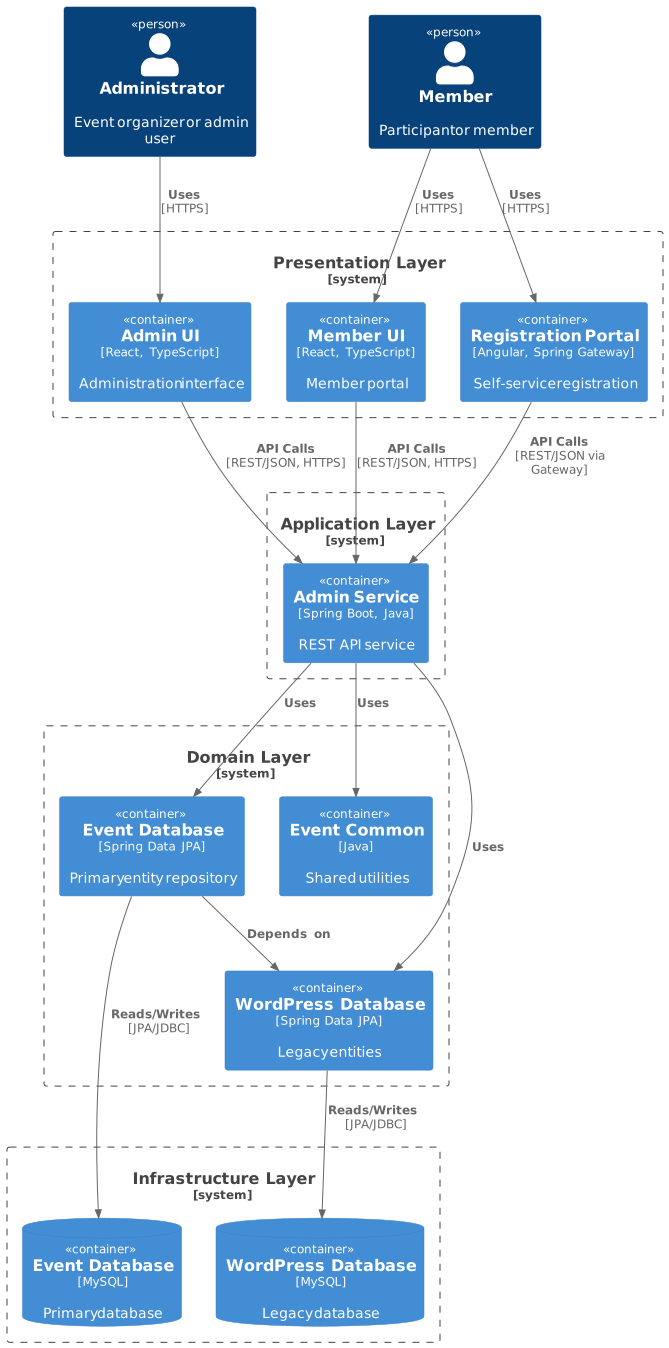
This document provides a detailed architectural overview of the Event and Membership Administration System components. It describes the design principles, architectural patterns, and component responsibilities that guide the system’s structure.
2. Architectural Style
The system employs a layered architecture with elements of microservices design:
-
Clear separation between presentation, application, domain, and infrastructure layers
-
Independent deployability of frontend and backend components
-
RESTful API communication between layers
-
Database-per-service pattern (logical separation within shared MySQL instance)
3. System Layers
3.1. Presentation Layer
Components: admin-ui, member-ui, registration-portal
Responsibilities:
-
User interface rendering
-
User interaction handling
-
Client-side validation
-
Session management
-
API request/response handling
Technologies:
-
admin-ui/member-ui: React 18 with functional components and hooks, TypeScript, Material-UI, Axios, React Router
-
registration-portal: Angular 17+, TypeScript, PrimeNG, Spring Cloud Gateway (BFF pattern)
|
The Registration Portal uses a different architecture pattern (JHipster gateway) compared to the React-based UIs. It acts as a Backend-for-Frontend, handling authentication and API routing server-side. See Registration Portal Architecture for details. |
3.2. Application Layer
Components: admin-service
Responsibilities:
-
Business logic implementation
-
API endpoint exposure
-
Request validation and error handling
-
Transaction management
-
Security and authorization
-
External service integration
Technologies:
-
Spring Boot 2.7+
-
Spring Web MVC
-
Spring Security
-
Spring Data JPA
-
Jackson for JSON serialization
3.3. Domain Layer
Components: event-database, wordpress-database, event-common
Responsibilities:
-
Entity definitions (JPA)
-
Repository interfaces
-
Domain logic and business rules
-
Data access abstractions
-
Shared utility functions
Technologies:
-
Jakarta Persistence API (JPA)
-
Hibernate ORM
-
Spring Data JPA
-
Bean Validation API
4. Component Descriptions
4.1. Parent POMs
4.1.1. event
The root parent POM that establishes the foundation for all Maven-based components in the system.
Repository: https://github.com/christhonie/event
Maven Coordinates:
<groupId>za.co.idealogic</groupId>
<artifactId>event</artifactId>
<version>${revision}</version>
<packaging>pom</packaging>
Responsibilities:
-
Version Management - Defines versions for all internal components
-
Dependency Management - Manages third-party dependency versions
-
Plugin Configuration - Standardizes build plugin configuration
-
Property Definitions - Defines common properties (Java version, encoding, etc.)
Key Properties:
<properties>
  <revision>1.2.0-SNAPSHOT</revision>
  <java.version>11</java.version>
  <maven.compiler.source>11</maven.compiler.source>
  <maven.compiler.target>11</maven.compiler.target>
  <project.build.sourceEncoding>UTF-8</project.build.sourceEncoding>
  <spring-boot.version>2.7.14</spring-boot.version>
</properties>
Managed Dependencies:
-
Spring Boot BOM
-
Spring Cloud dependencies
-
Database drivers (MySQL)
-
Utility libraries (Lombok, MapStruct, Commons Lang)
-
All internal components (event-common, event-database, etc.)
4.2. Common Libraries
4.2.1. event-common
Shared utility library providing common functionality used across all components.
Repository: https://github.com/christhonie/event-common
Maven Coordinates:
<groupId>za.co.idealogic</groupId>
<artifactId>event-common</artifactId>
<version>${revision}</version>
Package Structure:
za.co.idealogic.event.common
├── constants/          - System-wide constants
├── util/              - Utility classes
│   ├── DateUtils
│   ├── StringUtils
│   └── ValidationUtils
├── exception/         - Common exception classes
│   ├── BusinessException
│   ├── ValidationException
│   └── ResourceNotFoundException
└── dto/               - Shared DTOs
    ├── PageRequest
    ├── PageResponse
    └── ErrorResponse
Key Classes:
-
DateUtils - Date manipulation and formatting utilities
-
StringUtils - String processing utilities (complement to Apache Commons)
-
ValidationUtils - Common validation logic
-
BusinessException - Base exception for business rule violations
-
PageRequest/PageResponse - Pagination DTOs
Design Principles:
-
No business logic - Only utility and infrastructure code
-
Stateless - All utility methods are static
-
Well-tested - High unit test coverage
-
Minimal dependencies - Only essential third-party libraries
4.3. Database Libraries
See Database Components for detailed information about event-database and wordpress-database.
4.4. Backend Services
See Backend Services for detailed information about admin-service.
4.5. Frontend Applications
See Frontend Applications for detailed information about admin-ui and member-ui.
5. Architectural Patterns
5.1. Repository Pattern
All database access is abstracted through Spring Data JPA repositories:
public interface EventRepository extends JpaRepository<Event, Long> {
    List<Event> findByOrganisationId(Long organisationId);

    List<Event> findByStartDateBetween(LocalDate start, LocalDate end);

    @Query("SELECT e FROM Event e WHERE e.status = :status " +
           "AND e.organisation.id = :orgId")
    List<Event> findActiveEventsByOrganisation(
        @Param("orgId") Long orgId,
        @Param("status") EventStatus status
    );
}
Benefits:
-
Abstracts database access details
-
Provides type-safe queries
-
Enables easy testing with repository mocks
-
Supports query method derivation
5.2. Service Layer Pattern
Business logic is encapsulated in service classes:
@Service
@Transactional
public class EventService {
    private final EventRepository eventRepository;
    private final EventCategoryRepository categoryRepository;

    public Event createEvent(EventCreateRequest request) {
        // Validation
        validateEventDates(request);

        // Business logic
        Event event = new Event();
        event.setName(request.getName());
        event.setStartDate(request.getStartDate());
        event.setEndDate(request.getEndDate());

        // Persistence
        return eventRepository.save(event);
    }
}
Benefits:
-
Centralizes business logic
-
Provides transaction boundaries
-
Enables service-level security
-
Facilitates testing with service mocks
5.3. DTO Pattern
Data Transfer Objects separate API contracts from domain entities:
public class EventResponse {
    private Long id;
    private String name;
    private LocalDate startDate;
    private LocalDate endDate;
    private String status;
    private List<CategoryResponse> categories;

    // Getters and setters
}
Benefits:
-
API stability - internal entity changes don’t affect API
-
Security - prevents over-posting and data exposure
-
Performance - allows selective field loading
-
Versioning - supports multiple API versions
5.4. REST API Pattern
All backend services expose RESTful APIs:
@RestController
@RequestMapping("/api/events")
public class EventController {
    private final EventService eventService;

    @GetMapping
    public PageResponse<EventResponse> getEvents(
        @RequestParam(required = false) Long organisationId,
        @PageableDefault Pageable pageable
    ) {
        return eventService.getEvents(organisationId, pageable);
    }

    @PostMapping
    @ResponseStatus(HttpStatus.CREATED)
    public EventResponse createEvent(@Valid @RequestBody EventCreateRequest request) {
        return eventService.createEvent(request);
    }

    @GetMapping("/{id}")
    public EventResponse getEvent(@PathVariable Long id) {
        return eventService.getEvent(id);
    }
}
REST Conventions:
-
HTTP methods: GET (read), POST (create), PUT (full update), PATCH (partial update), DELETE (remove)
-
Status codes: 200 (OK), 201 (Created), 204 (No Content), 400 (Bad Request), 404 (Not Found), 500 (Server Error)
-
Resource naming: Plural nouns (
/events,/participants) -
Pagination: Query parameters (
page,size,sort)
6. Cross-Cutting Concerns
6.1. Security
Implemented at the application layer using Spring Security:
-
Authentication - JWT token-based authentication
-
Authorization - Role-based access control (RBAC)
-
Multi-Tenancy - Organisation-scoped security
-
Person-Level Security - User-specific data access
See Security Architecture for details.
6.2. Transaction Management
Managed by Spring’s declarative transaction management:
-
@Transactionalannotations on service methods -
Transaction propagation and isolation levels
-
Rollback rules for checked/unchecked exceptions
6.3. Error Handling
Centralized error handling using @ControllerAdvice:
@ControllerAdvice
public class GlobalExceptionHandler {
    @ExceptionHandler(BusinessException.class)
    public ResponseEntity<ErrorResponse> handleBusinessException(BusinessException ex) {
        return ResponseEntity
            .status(HttpStatus.BAD_REQUEST)
            .body(new ErrorResponse(ex.getCode(), ex.getMessage()));
    }

    @ExceptionHandler(ResourceNotFoundException.class)
    public ResponseEntity<ErrorResponse> handleNotFound(ResourceNotFoundException ex) {
        return ResponseEntity
            .status(HttpStatus.NOT_FOUND)
            .body(new ErrorResponse("NOT_FOUND", ex.getMessage()));
    }
}7. Component Communication
7.1. Synchronous Communication
HTTP REST APIs:
-
Frontend → Backend: REST API calls over HTTPS
-
Request/Response pattern
-
JSON payload format
-
Correlation IDs for tracing
Example Flow:
1. User clicks "Create Event" in admin-ui
2. admin-ui sends POST /api/events with JSON payload
3. admin-service validates request
4. admin-service executes business logic
5. admin-service persists data via event-database
6. admin-service returns EventResponse JSON
7. admin-ui displays success message
7.2. Asynchronous Communication
Currently, the system uses synchronous communication only. Future enhancements may include:
-
Message Queue - For background processing (email notifications, reports)
-
Event Bus - For domain events and eventual consistency
-
WebSockets - For real-time updates (live race results)
8. Scalability Considerations
8.1. Horizontal Scaling
Frontend Applications:
-
Stateless design enables easy scaling
-
Can be served via CDN
-
Multiple instances behind load balancer
Backend Services:
-
Stateless REST APIs enable horizontal scaling
-
Session data stored in shared cache (Redis)
-
Multiple instances behind load balancer
9. Deployment Architecture
Components are deployed as separate artifacts:
-
Frontend - Static files served by Nginx or CDN
-
Backend - Spring Boot executable JAR
-
Database - MySQL server instances
See Deployment Documentation for detailed deployment procedures.
10. Development Environment
10.1. Local Development Setup
Prerequisites:
-
JDK 11 or later
-
Maven 3.8+
-
Node.js 16+ and npm 8+
-
MySQL 8.0+
-
IDE (IntelliJ IDEA, VS Code, Eclipse)
Build Process:
# Clone repositories
git clone https://github.com/christhonie/event
git clone https://github.com/christhonie/event-common
git clone https://github.com/christhonie/event-database
git clone https://github.com/christhonie/admin-service
git clone https://github.com/christhonie/admin-ui

# Build parent and libraries
cd event && mvn clean install
cd ../event-common && mvn clean install
cd ../event-database && mvn clean install

# Build and run backend
cd ../admin-service
mvn spring-boot:run

# Build and run frontend
cd ../admin-ui
npm install
npm start
10.2. Testing Strategy
Unit Tests:
-
JUnit 5 for Java components
-
Jest for React components
-
Mockito for mocking dependencies
-
High code coverage targets (>80%)
Integration Tests:
-
Spring Boot Test for service integration tests
-
Testcontainers for database integration tests
-
REST Assured for API testing
End-to-End Tests:
-
Cypress or Playwright for UI tests
-
Test complete user workflows
-
Run in CI/CD pipeline