Technical Specification
1. Executive Summary
This document specifies a computer vision-based system designed to augment existing RFID timing infrastructure at cycling events. The primary objective is to reduce missed tag reads, particularly in lapped races where a single missed read places a participant one lap behind.
The proposed solution leverages existing CCTV infrastructure (Hikvision DS-7600 series NVR) to provide a secondary detection mechanism. By correlating video-based bicycle detections with RFID triggers, the system identifies gaps in timing data and assists operators in resolving discrepancies.
The system operates on the principle of adaptive resource allocation: when RFID timing is working reliably (>98% correlation), the vision system runs in passive mode — detecting and archiving but not creating operator tasks or consuming resources on re-identification. When discrepancies occur, the system escalates through processing modes (NORMAL → ALERT → CRITICAL), increasing operator involvement proportionally.
-
Up to 300 participants per race
-
Up to 2000 participants per event day
-
Peak crossing rate: 10 cyclists in 5 seconds (sprint finishes)
-
4+ cameras per finish line
-
Real-time bicycle detection using deep learning models (YOLO-based)
-
Multi-camera fusion with calibration and automatic drift detection
-
Adaptive processing modes based on correlation success rate
-
Integration with race administration for scheduling context
-
Integration with custom tag-server via MQTT/WebSocket
-
Operator workflow for discrepancy resolution with task prioritisation
-
Post-race batch review for archived detections
2. Problem Statement
2.1. Current Situation
RFID timing systems are the standard for cycling events, using passive tags mounted on frame boards. Whilst generally reliable, these systems exhibit inherent inaccuracies resulting in occasional missed reads.
-
Tag orientation relative to antenna
-
Metal interference from bicycle frames
-
Multiple tags in the read zone simultaneously (peloton crossings)
-
Environmental conditions (moisture, temperature)
-
Reader antenna positioning and power settings
2.2. Impact
In single-lap races, a missed read requires manual intervention but is easily detected at the finish. In lapped races, the impact is severe: a single missed read places the participant one lap behind the group, fundamentally corrupting their results. Manual detection requires cross-referencing multiple data sources and is error-prone under time pressure.
3. Design Philosophy
3.1. Augmentation, Not Replacement
The RFID timing system remains the primary and authoritative source for race timing. The vision system serves as an augmentation layer that:
-
Provides a safety net for missed RFID reads
-
Adds a secondary audit trail for disputed results
-
Assists operators during high-density crossings
-
Does not add overhead when RFID is functioning correctly
When RFID is working well, the vision system should be nearly invisible. When discrepancies occur, it becomes the operator’s most valuable tool.
3.2. Adaptive Resource Allocation
Processing video streams and running re-identification models consumes significant resources (GPU, operator attention, storage). The system adapts its behaviour based on the current correlation success rate:
| Correlation | System Behaviour | Operator Experience |
|---|---|---|
Excellent (>98%) |
PASSIVE mode: detection only, re-ID skipped, no tasks |
Dashboard shows "All Clear"; minimal attention required |
Good (90-98%) |
NORMAL mode: full pipeline, tasks for discrepancies |
Occasional task queue items to review |
Degraded (<90%) |
ALERT mode: aggressive re-ID, all gaps prioritised |
Elevated attention; audible notifications |
Failed (<70% or lost) |
CRITICAL mode: video primary, all detections → tasks |
Full manual verification required |
3.3. Race Context Awareness
The system integrates with race administration to understand:
-
Which participants are eligible to cross at any given time
-
Expected lap times and race duration
-
When races start and finish
This context enables intelligent filtering (ignore detections outside race windows) and improved matching (predict expected crossing times).
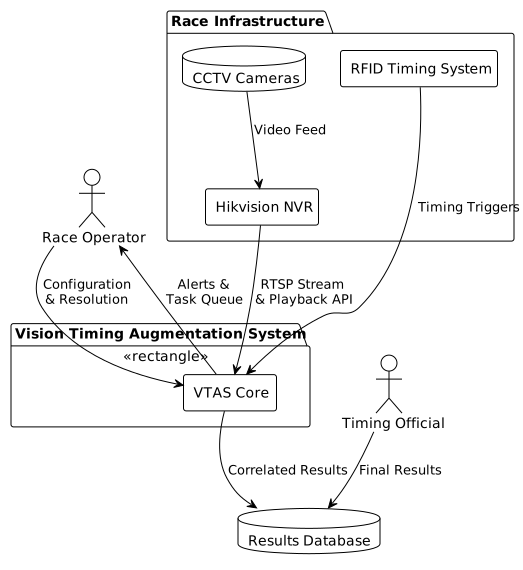
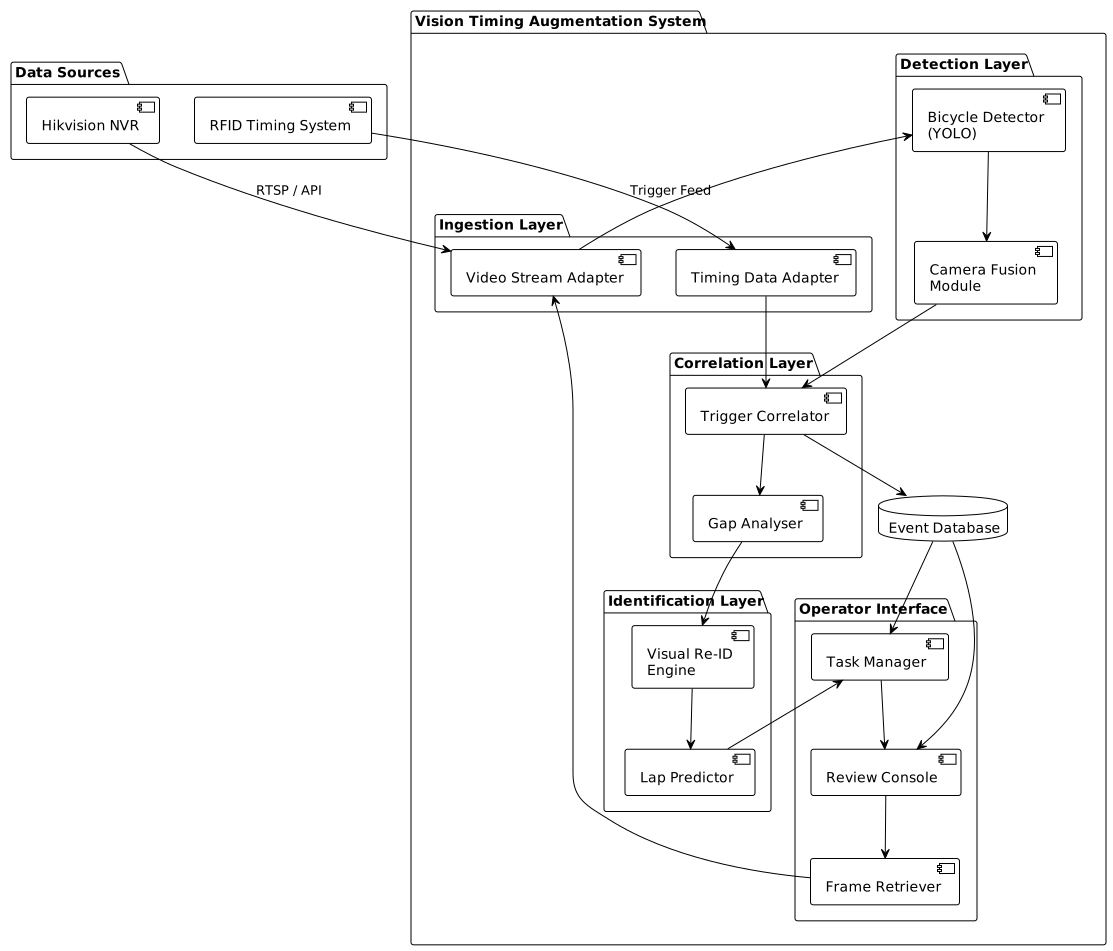
5. Functional Requirements
5.1. Module 1: Video Stream Adapter (VSA)
Interface with the Hikvision NVR to provide both live and recorded video streams to downstream components.
| ID | Requirement | Priority |
|---|---|---|
VSA-01 |
SHALL connect to Hikvision NVR via RTSP for live streaming |
Must |
VSA-02 |
SHALL support retrieval of recorded footage via Hikvision ISAPI for specified time ranges |
Must |
VSA-03 |
SHALL support multiple simultaneous camera streams (minimum 4 cameras) |
Must |
VSA-04 |
SHALL provide frame-accurate timestamp synchronisation across all streams |
Must |
VSA-05 |
SHALL handle stream disconnection gracefully with automatic reconnection |
Must |
VSA-06 |
SHALL expose a unified API for frame retrieval (live or recorded) by timestamp |
Should |
VSA-07 |
SHOULD support configurable frame rate decimation to reduce processing load |
Should |
VSA-08 |
SHALL log all stream interruptions with duration and recovery status |
Must |
5.1.1. Hikvision DS-7600 Series Integration
The Hikvision DS-7600NI series (Pro) NVRs support both RTSP streaming and ISAPI for programmatic access.
# Main stream (full resolution)
rtsp://<username>:<password>@<nvr-ip>:554/Streaming/Channels/<channel>01

# Sub stream (lower resolution, reduced bandwidth)
rtsp://<username>:<password>@<nvr-ip>:554/Streaming/Channels/<channel>02

# Example: Camera 1 main stream
rtsp://admin:[email protected]:554/Streaming/Channels/101# Search for recordings
POST /ISAPI/ContentMgmt/search
Content-Type: application/xml
<CMSearchDescription>
<searchID>search-001</searchID>
<trackList><trackID>101</trackID></trackList>
<timeSpanList>
<timeSpan>
<startTime>2025-12-08T14:30:00Z</startTime>
<endTime>2025-12-08T14:35:00Z</endTime>
</timeSpan>
</timeSpanList>
<maxResults>100</maxResults>
<searchResultPostion>0</searchResultPostion>
</CMSearchDescription>
# Retrieve playback stream
GET /ISAPI/ContentMgmt/download?playbackURI=<uri-from-search>| Feature | Support |
|---|---|
Maximum channels |
8, 16, or 32 depending on model variant |
Recording resolution |
Up to 12MP per channel |
RTSP streaming |
Yes — main and sub streams per channel |
ISAPI |
Yes — full ContentMgmt API for search and playback |
H.265/H.264 |
Both supported |
NTP synchronisation |
Yes — configurable NTP server |
Timestamp in stream |
Yes — embedded in frame metadata |
Simultaneous playback streams |
Typically 4-8 concurrent streams |
-
Use sub-stream for real-time detection if bandwidth is constrained; main stream for review
-
Frame timestamps should be extracted from RTSP RTP packets, not system clock
-
ISAPI requires digest authentication; maintain session for performance
-
Consider caching recent footage locally to reduce NVR load during review
-
See Camera Specifications for bandwidth and processing calculations
-
Consider hardware-accelerated decoding (NVDEC) for multiple streams
-
Test maximum concurrent playback streams with your specific NVR model
| Parameter | Value |
|---|---|
Resolution |
3 MP (typically 2048 × 1536 or 2304 × 1296) |
Frame Rate |
30 fps (standard) or 60 fps (high-speed capture) |
Colour |
Yes (RGB) |
Codec (assumed) |
H.264 or H.265 |
| Scenario | Per Camera | 4 Cameras | 8 Cameras |
|---|---|---|---|
3MP @ 30fps (H.264, high quality) |
8-12 Mbps |
32-48 Mbps |
64-96 Mbps |
3MP @ 60fps (H.264, high quality) |
15-20 Mbps |
60-80 Mbps |
120-160 Mbps |
3MP @ 30fps (H.265) |
4-6 Mbps |
16-24 Mbps |
32-48 Mbps |
3MP @ 60fps (H.265) |
8-12 Mbps |
32-48 Mbps |
64-96 Mbps |
| Gigabit Ethernet (1 Gbps) is sufficient for up to 8 cameras at 60fps with H.264. For reliability and headroom, 10 GbE or dedicated network segment is recommended for 6+ cameras. |
At 3MP resolution, each frame is approximately 9.4 megapixels (uncompressed). For YOLO inference:
-
30 fps per camera — Requires ~33ms per frame for real-time processing
-
60 fps per camera — Requires ~16ms per frame for real-time processing
Recommendation: Process at 30 fps even if cameras capture at 60 fps. The additional temporal resolution provides no significant benefit for finish line detection, but the 60 fps stream can be retained for high-quality playback during review.
Camera captures:  60 fps → NVR (full quality recording)
                       ↓
                  30 fps → Bicycle Detector (real-time processing)
                       ↓
                  On-demand → Frame Retriever (review at 60 fps)
5.2. Module 2: Bicycle Detector (BD)
Process video frames to detect bicycles and their positions within each frame, providing trigger events when bicycles cross the finish line zone.
| ID | Requirement | Priority |
|---|---|---|
BD-01 |
SHALL detect bicycles in video frames using a deep learning model (YOLOv8 or equivalent) |
Must |
BD-02 |
SHALL provide bounding box coordinates for each detected bicycle |
Must |
BD-03 |
SHALL assign confidence scores to each detection |
Must |
BD-04 |
SHALL process frames at minimum 15 fps per camera on target hardware |
Must |
BD-05 |
SHALL distinguish bicycles from other objects (cars, pedestrians, motorcycles) |
Must |
BD-06 |
SHALL support configurable detection zones (regions of interest) per camera |
Must |
BD-07 |
SHALL generate trigger events only when a bicycle enters/exits the finish line zone |
Must |
BD-08 |
SHOULD track individual bicycles across frames within a single camera view |
Should |
BD-09 |
SHALL operate with acceptable accuracy under varying lighting conditions |
Must |
BD-10 |
SHOULD support model fine-tuning for cycling-specific scenarios |
Could |
-
Pre-trained YOLO models include "bicycle" class but may need fine-tuning for racing bikes with riders
-
Consider training on a custom dataset including frame boards and bib numbers
-
GPU acceleration essential: NVIDIA RTX 3060 or better recommended for 4 cameras
5.3. Module 3: Camera Fusion Module (CFM)
Combine detections from multiple cameras to produce unified trigger events, avoiding duplicate triggers for the same cyclist crossing. For portable setups, detect camera movement and notify operators when recalibration is required.
| ID | Requirement | Priority |
|---|---|---|
CFM-01 |
SHALL provide a calibration workflow to establish camera positions relative to the finish line |
Must |
CFM-02 |
SHALL determine the spatial relationship between overlapping camera views |
Must |
CFM-03 |
SHALL merge detections from multiple cameras viewing the same finish line crossing |
Must |
CFM-04 |
SHALL assign a single timestamp to merged detections (earliest detection or configurable) |
Must |
CFM-05 |
SHALL handle non-overlapping camera views (e.g., approach camera + finish camera) |
Should |
CFM-06 |
SHALL tolerate camera time drift up to 100ms through synchronisation |
Must |
CFM-07 |
SHALL indicate which camera(s) contributed to each fused detection |
Must |
CFM-08 |
SHOULD support dynamic masking of obstructed regions |
Should |
CFM-09 |
SHALL detect camera movement beyond acceptable tolerance and alert operator |
Must |
CFM-10 |
SHALL continuously validate calibration against reference points |
Must |
CFM-11 |
SHALL support rapid field recalibration (target: <2 minutes per camera) |
Must |
CFM-12 |
SHOULD auto-correct for minor drift within tolerance (±2° rotation, ±5% translation) |
Should |
5.3.1. Camera Drift Detection
For portable pole/fence-mounted cameras, environmental factors (wind, vibration, accidental contact) can shift camera position during an event. Although pole and fence clamps provide better rigidity than tripods, each setup is unique and drift detection remains important.
| Mount Type | Stability | Drift Risk |
|---|---|---|
Fence post clamp |
Good — rigid attachment to fixed infrastructure |
Low (unless fence itself moves) |
Pole mount (dedicated) |
Good — purpose-built stability |
Low to Medium (pole flex in wind) |
Tripod (fallback) |
Moderate — susceptible to ground conditions |
Medium to High |
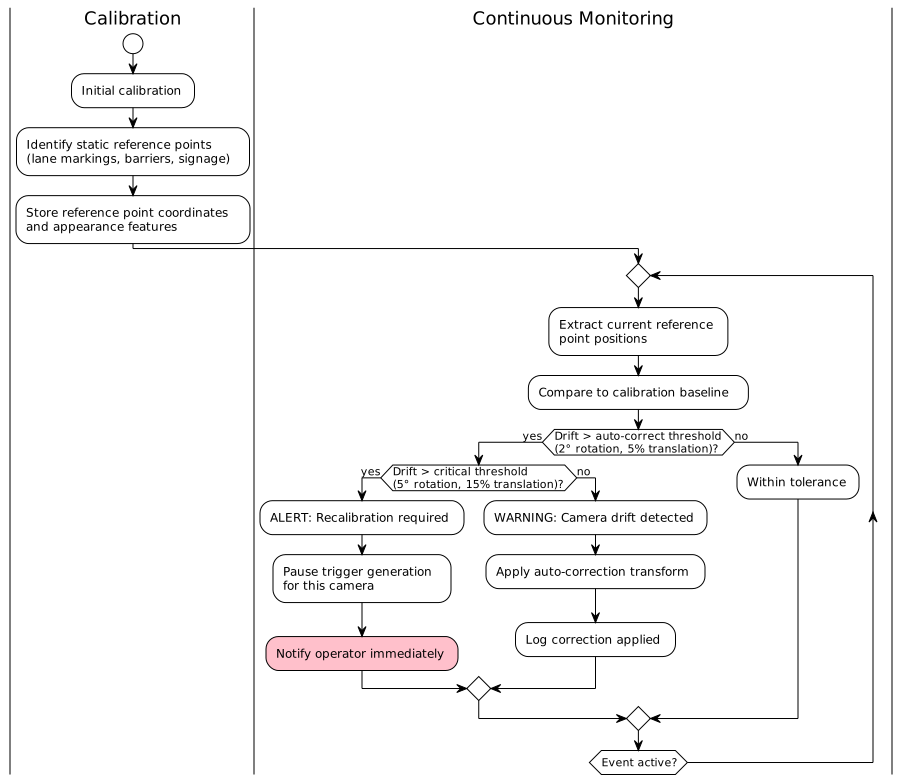
During calibration, the operator identifies 4-6 static reference points visible in each camera view:
| Reference Type | Examples | Reliability |
|---|---|---|
Ground markings |
Finish line paint, lane dividers, distance markers |
High |
Fixed infrastructure |
Barrier posts, fence corners, timing gantry edges |
High |
Temporary markers |
Calibration targets placed for the event |
Medium (can be moved) |
Natural features |
Road texture patterns, cracks, drain covers |
Medium (lighting dependent) |
For minor drift within tolerance, the system applies a corrective homography transformation:
-
Detect current positions of reference points using template matching
-
Calculate transformation matrix between baseline and current positions
-
Apply inverse transformation to detection coordinates
-
Log correction magnitude and direction
| Level | Condition | System Response | Operator Action |
|---|---|---|---|
INFO |
Drift detected, auto-corrected |
Log entry, continue operation |
Review at convenience |
WARNING |
Approaching auto-correct limit |
Audible alert, UI notification |
Monitor; recalibrate at next opportunity |
CRITICAL |
Beyond auto-correct capability |
Suspend camera, loud alert, UI banner |
Immediate recalibration required |
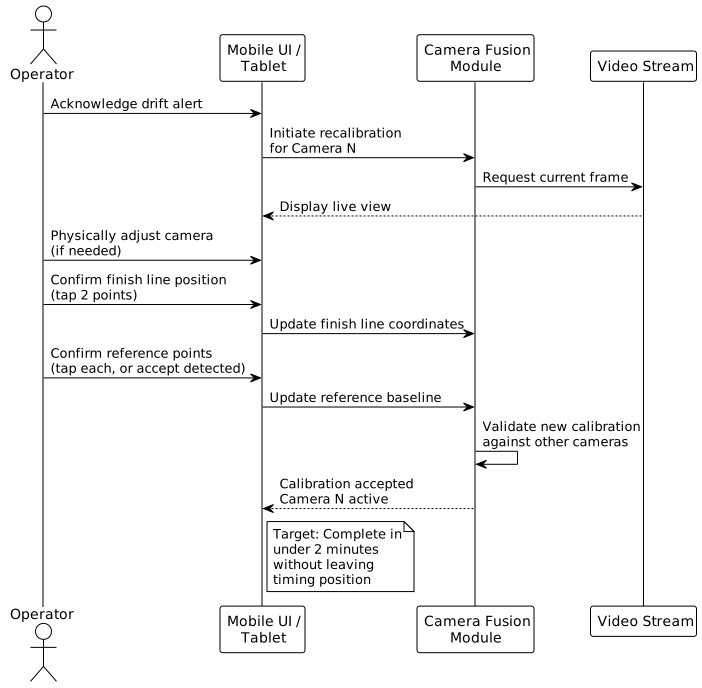
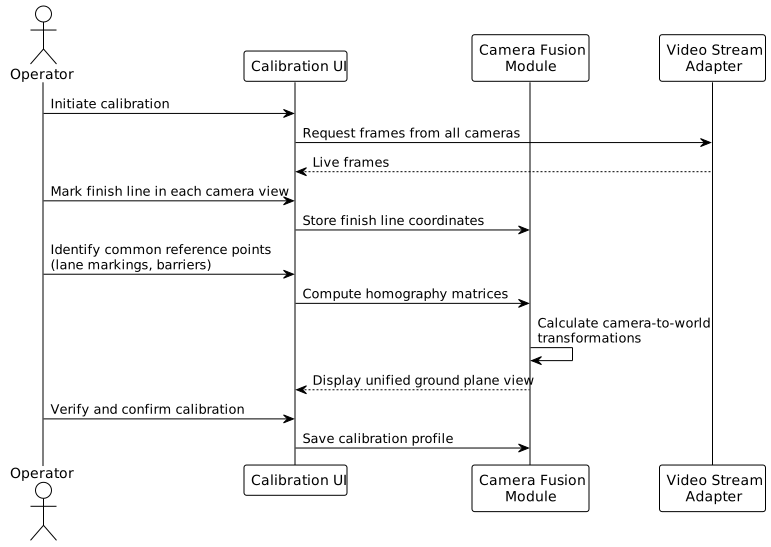
5.4. Module 4a: Race Context Provider (RCP)
Integrate with race administration software to provide scheduling context, enabling intelligent filtering and prioritisation throughout the system.
| ID | Requirement | Priority |
|---|---|---|
RCP-01 |
SHALL receive race schedule from administration software (start times, expected duration) |
Must |
RCP-02 |
SHALL maintain "no earlier than" constraint per participant based on scheduled start |
Must |
RCP-03 |
SHALL calculate expected race end time based on schedule and observed performance |
Must |
RCP-04 |
SHALL provide current race context (which race is active, time into race, expected remaining) |
Must |
RCP-05 |
SHALL identify participants eligible to cross at any given time |
Must |
RCP-06 |
SHALL detect when a race is effectively complete (bulk of participants finished) |
Should |
RCP-07 |
SHOULD support multiple concurrent races with different start times |
Should |
RCP-08 |
SHALL expose API for other modules to query participant eligibility |
Must |
{
  "race_id": "race_2025_elite_men",
  "name": "Elite Men 50km",
  "scheduled_start": "2025-12-08T09:00:00Z",
  "actual_start": "2025-12-08T09:02:15Z",
  "expected_duration_minutes": 75,
  "laps": 10,
  "participant_count": 45,
  "status": "IN_PROGRESS",
  "participants": [
    {
      "bib_number": "42",
      "earliest_crossing": "2025-12-08T09:02:15Z",
      "expected_lap_time_seconds": 450
    }
  ]
}Before creating a detection task or attempting re-identification, verify the crossing is plausible:
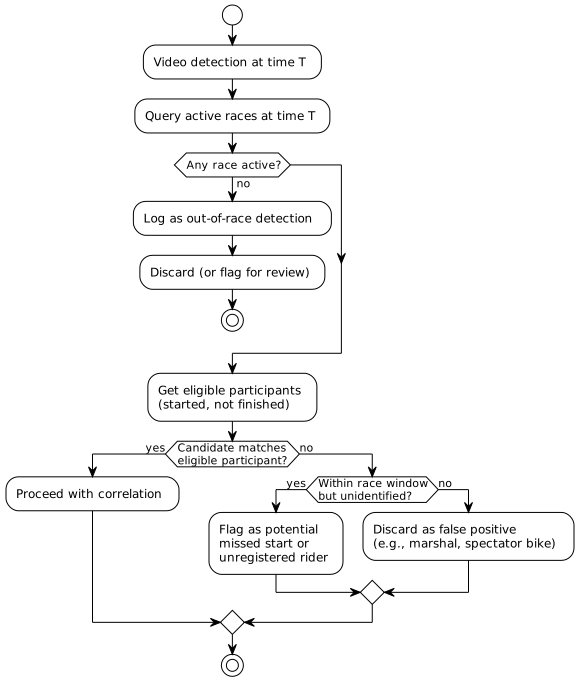
The Race Context Provider should sync with your existing race administration system. Options:
| Method | Description | Recommendation |
|---|---|---|
REST API polling |
Query administration software every 30-60 seconds for schedule updates |
Good for loosely coupled systems |
Webhook/push |
Administration software notifies RCP of schedule changes |
Better for real-time accuracy |
Shared database |
Direct read access to administration database |
Fastest, but tighter coupling |
File import |
Load race schedule from exported file at event start |
Simplest; manual update if changes occur |
5.5. Module 4b: Timing Data Adapter (TDA)
Interface with the existing tag-server to receive trigger events and participant identification.
| ID | Requirement | Priority |
|---|---|---|
TDA-01 |
SHALL receive real-time triggers from the tag-server |
Must |
TDA-02 |
SHALL capture participant identifier (tag ID mapped to bib number) for each trigger |
Must |
TDA-03 |
SHALL capture precise timestamp for each trigger (millisecond precision minimum) |
Must |
TDA-04 |
SHALL connect to tag-server via MQTT (recommended) or WebSocket streaming |
Must |
TDA-05 |
SHALL normalise timestamps to a common time base with video streams |
Must |
TDA-06 |
SHALL maintain a buffer of recent triggers for correlation purposes (minimum 60 seconds) |
Must |
TDA-07 |
SHALL detect and flag tag-server disconnections within 5 seconds |
Must |
TDA-08 |
SHOULD support REST API polling as fallback when streaming unavailable |
Should |
TDA-09 |
SHOULD support import of timing data from file (for post-race analysis) |
Should |
TDA-10 |
SHALL acknowledge receipt of triggers to tag-server (if protocol supports) |
Should |
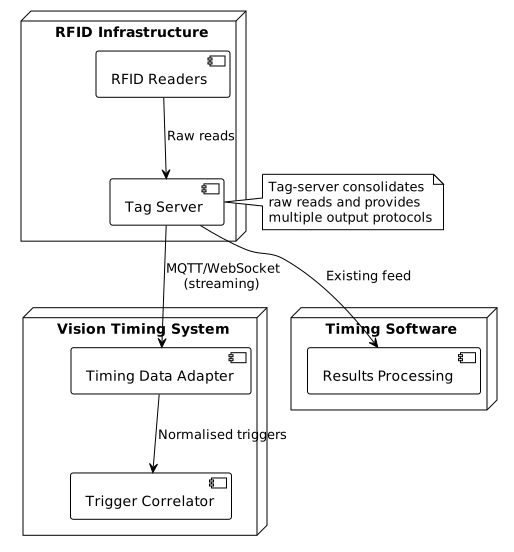
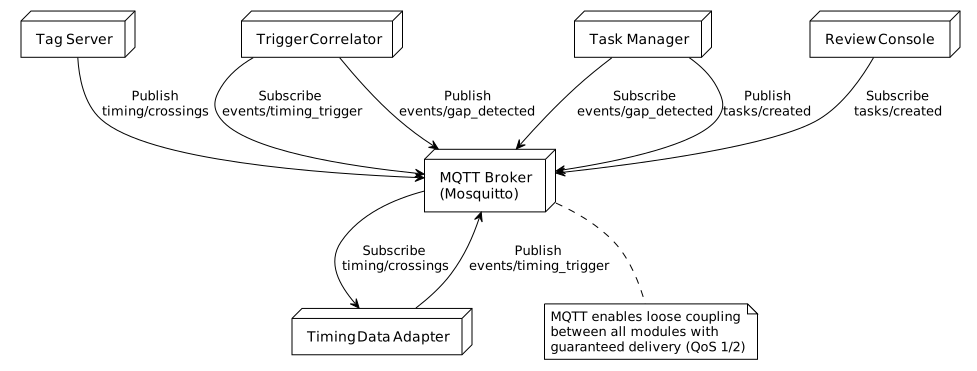
MQTT is the recommended protocol for tag-server integration due to:
-
Low latency — Persistent connection with minimal overhead
-
Guaranteed delivery — QoS levels ensure no missed triggers
-
Scalability — Multiple subscribers without additional load on tag-server
-
Resilience — Automatic reconnection and session persistence
-
Decoupling — Vision system doesn’t affect existing timing software feed
timing/{event_id}/crossings       # All crossing events
timing/{event_id}/crossings/{bib} # Per-participant (optional)
timing/{event_id}/status # System health/heartbeat{
"event_id": "evt_2025_criterium_01",
"timestamp": "2025-12-08T14:32:15.847Z",
"tag_id": "E200001234567890",
"bib_number": "42",
"reader_id": "finish_line_1",
"signal_strength": -45,
"read_count": 3,
"sequence": 15847
}If MQTT infrastructure is not available, WebSocket provides similar benefits with simpler deployment. The tag-server would expose a WebSocket endpoint that streams JSON messages in the same format.
For post-race analysis or degraded operation, a REST endpoint can provide batch retrieval:
GET /api/crossings?event_id={id}&since={timestamp}&limit=1005.6. Module 5: Trigger Correlator (TC)
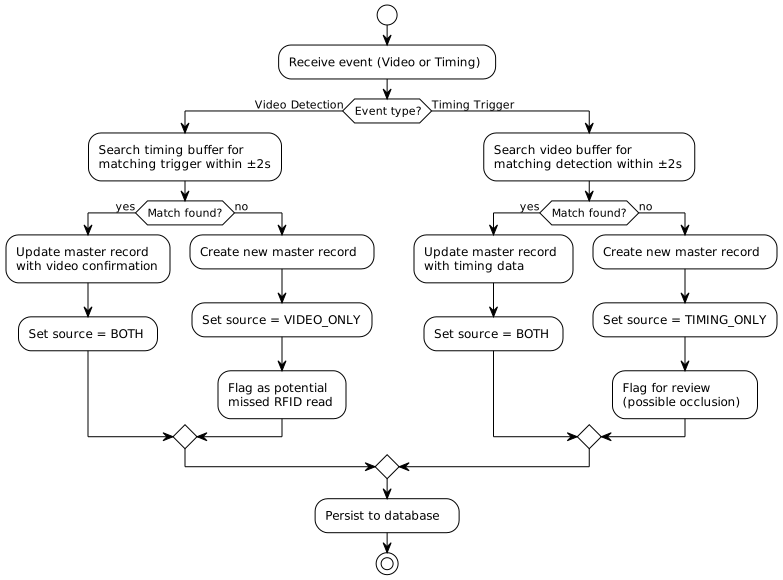
Match video-based detections with RFID timing triggers to identify gaps and build a unified crossing log. Adapt processing priority based on correlation success rate.
| ID | Requirement | Priority |
|---|---|---|
TC-01 |
SHALL correlate video detections with timing triggers within a configurable time window (default ±2 seconds) |
Must |
TC-02 |
SHALL classify each event as: matched (both sources), video-only, or timing-only |
Must |
TC-03 |
SHALL maintain a master trigger list combining all sources |
Must |
TC-04 |
SHALL record the source(s) for each trigger in the master list |
Must |
TC-05 |
SHALL flag "video-only" events as potential missed RFID reads |
Must |
TC-06 |
SHALL flag "timing-only" events as potential false reads or camera occlusion |
Should |
TC-07 |
SHALL support configurable correlation strategies (timestamp only, timestamp + lane position) |
Should |
TC-08 |
SHALL generate gap reports per source system |
Must |
TC-09 |
SHALL calculate rolling correlation success rate |
Must |
TC-10 |
SHALL adjust processing mode based on correlation success rate |
Must |
TC-11 |
SHALL deprioritise video identification when correlation is high |
Should |
5.6.1. Adaptive Processing Modes
The system operates in different modes based on how well RFID and video triggers are correlating. When RFID is working reliably, video identification is unnecessary overhead. When discrepancies occur, video becomes critical.
| Mode | Trigger | Behaviour | Resource Usage |
|---|---|---|---|
PASSIVE |
Correlation rate >98% over last 5 minutes |
Video detection runs but re-ID is skipped; frames stored for retrieval if needed later; minimal task creation |
Low |
NORMAL |
Correlation rate 90-98% |
Full pipeline active; re-ID runs on unmatched detections; tasks created for video-only events |
Medium |
ALERT |
Correlation rate <90% OR >3 consecutive misses |
Aggressive re-ID on all detections; operator notified of degraded RFID; all gaps prioritised |
High |
CRITICAL |
RFID feed lost OR correlation rate <70% |
Video becomes primary source; all detections generate tasks; operator alerted to investigate RFID |
Maximum |
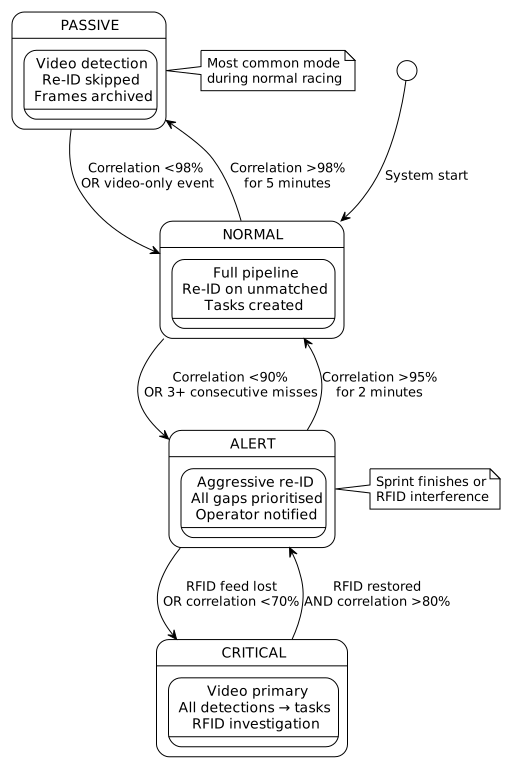
Rolling window: Last 5 minutes OR last 50 RFID triggers (whichever is smaller)

correlation_rate = matched_triggers / total_rfid_triggers

Where:
- matched_triggers = RFID triggers with corresponding video detection within ±2 sec
- total_rfid_triggers = All RFID triggers in windowPASSIVE Mode (Correlation >98%)
-
Video detection continues (for audit trail and potential later review)
-
Re-identification engine is not invoked — saves GPU cycles
-
Frames are archived with crossing timestamp for retrieval if needed
-
No tasks created for well-correlated crossings
-
Operator dashboard shows "RFID Primary — Video Standby"
NORMAL Mode (Correlation 90-98%)
-
Full pipeline operational
-
Re-ID runs only on video-only or low-confidence detections
-
Tasks created for discrepancies requiring review
-
Operator dashboard shows active correlation statistics
ALERT Mode (Correlation <90%)
-
Re-ID runs on all detections (not just unmatched)
-
Builds comprehensive visual identity gallery
-
All video-only events immediately queued as high-priority tasks
-
Audible alert to operator: "RFID correlation degraded"
-
System prepares for potential full video reliance
CRITICAL Mode (RFID lost or <70%)
-
Video becomes the primary timing source
-
Every detection generates a task (identification required)
-
Operator receives urgent notification: "RFID failure — manual verification required"
-
System logs all detections for post-race reconciliation
-
Consider pausing race if safe to do so
Operators can manually set processing mode:
-
Force ALERT mode before anticipated sprint finish
-
Force PASSIVE mode if false video detections are overwhelming the queue
-
Lock mode to prevent automatic transitions during critical race phases
5.7. Module 6: Visual Re-Identification Engine (VRIE)
Assign consistent visual identifiers to cyclists across multiple crossings, enabling tracking without relying solely on RFID data.
| ID | Requirement | Priority |
|---|---|---|
VRI-01 |
SHALL extract visual features from detected cyclists (appearance embedding) |
Must |
VRI-02 |
SHALL assign a temporary visual identifier (VID) to each unique cyclist appearance |
Must |
VRI-03 |
SHALL match new detections against existing VIDs with confidence scoring |
Must |
VRI-04 |
SHALL link VIDs to participant identifiers when RFID data is available |
Must |
VRI-05 |
SHALL maintain a gallery of reference images per VID for operator review |
Must |
VRI-06 |
SHOULD utilise jersey colour, helmet colour, and bicycle colour as features |
Should |
VRI-07 |
SHOULD support manual linking of VIDs to participants by operator |
Should |
VRI-08 |
SHALL handle appearance variations due to lighting changes |
Must |
VRI-09 |
COULD attempt OCR on frame boards or bib numbers |
Could |
-
Person re-identification models (e.g., OSNet, TransReID) can be adapted for cyclists
-
Feature extraction should focus on stable attributes: kit colours, bike frame, helmet
-
OCR on frame boards is challenging due to motion blur and angle; treat as enhancement
5.8. Module 7: Lap Predictor (LP)
Predict expected crossing times based on historical lap data to assist matching and highlight anomalies.
| ID | Requirement | Priority |
|---|---|---|
LP-01 |
SHALL calculate average lap time per participant from confirmed crossings |
Must |
LP-02 |
SHALL predict expected crossing time for next lap (with confidence interval) |
Must |
LP-03 |
SHALL account for typical lap time degradation over race duration |
Should |
LP-04 |
SHALL flag detections that fall within expected windows for unmatched participants |
Must |
LP-05 |
SHALL provide probability scores for candidate matches based on timing predictions |
Must |
LP-06 |
SHALL detect anomalies (e.g., lap time <50% or >150% of average) |
Should |
LP-07 |
SHOULD incorporate race context (lead group pace, weather conditions) |
Could |
Where:
-
\$T_{expected}(n+1)\$ = Expected time for lap n+1
-
\$T_{last}\$ = Timestamp of last confirmed crossing
-
\$\bar{L}\$ = Mean lap time for this participant
-
\$\delta_{degradation}\$ = Degradation factor (typically 0.5-2% per lap)
5.9. Module 8: Task Manager ™
Maintain a prioritised queue of human tasks for resolving discrepancies. Adapt task creation and prioritisation based on current processing mode and race context.
| ID | Requirement | Priority |
|---|---|---|
TM-01 |
SHALL create tasks for video-only detections requiring resolution (when in NORMAL or higher mode) |
Must |
TM-02 |
SHALL prioritise tasks by: race position impact, time elapsed, confidence level, processing mode |
Must |
TM-03 |
SHALL assign tasks to operators (manual or automatic) |
Should |
TM-04 |
SHALL track task status: pending, in-progress, resolved, deferred |
Must |
TM-05 |
SHALL record resolution outcome and operator notes |
Must |
TM-06 |
SHALL provide task filtering by type, priority, status, and race |
Must |
TM-07 |
SHALL support bulk operations (e.g., dismiss all low-confidence tasks) |
Should |
TM-08 |
SHALL maintain audit trail of all task state changes |
Must |
TM-09 |
SHALL integrate with Review Console for task execution |
Must |
TM-10 |
SHALL suppress task creation in PASSIVE mode (archive for later review only) |
Must |
TM-11 |
SHALL escalate all tasks to high priority when in ALERT or CRITICAL mode |
Must |
TM-12 |
SHALL provide post-race batch review mode for deferred tasks |
Should |
5.9.1. Task Creation by Processing Mode
| Mode | Task Creation | Rationale |
|---|---|---|
PASSIVE |
No tasks created; detections archived with frames for potential later review |
RFID is reliable; video serves as backup audit trail only |
NORMAL |
Tasks created for video-only detections and timing anomalies |
Standard operation; discrepancies require attention |
ALERT |
Tasks created immediately with elevated priority; operator notified |
RFID degraded; video identification becomes important |
CRITICAL |
All detections create tasks; urgent notification to operator |
RFID failed; manual verification required for all crossings |
5.9.2. Task Prioritisation Algorithm
Tasks are scored based on multiple factors:
priority_score =
    base_priority(task_type)
  + mode_modifier(current_mode)
  + race_position_impact(estimated_position)
  + time_urgency(time_since_detection)
+ confidence_modifier(detection_confidence)| Component | Calculation | Range |
|---|---|---|
Base priority |
VIDEO_ONLY=50, TIMING_ANOMALY=40, REIDENTIFICATION=30 |
30-50 |
Mode modifier |
PASSIVE=0, NORMAL=0, ALERT=+30, CRITICAL=+50 |
0-50 |
Race position impact |
Potential podium=+25, Top 10=+15, Mid-pack=+5 |
0-25 |
Time urgency |
+1 per minute since detection (max +20) |
0-20 |
Confidence modifier |
High confidence=-10, Low confidence=+10 |
−10 to +10 |
Scenario A: PASSIVE mode, video-only detection
-
No task created
-
Detection and frames archived
-
Available for post-race review if needed
Scenario B: NORMAL mode, video-only detection, mid-pack rider
-
Base: 50 + Mode: 0 + Position: 5 + Time: 0 + Confidence: 0 = 55
-
Task created, queued at normal priority
Scenario C: ALERT mode, video-only detection, potential podium
-
Base: 50 + Mode: 30 + Position: 25 + Time: 0 + Confidence: 0 = 105
-
Task created immediately, high priority, operator notified
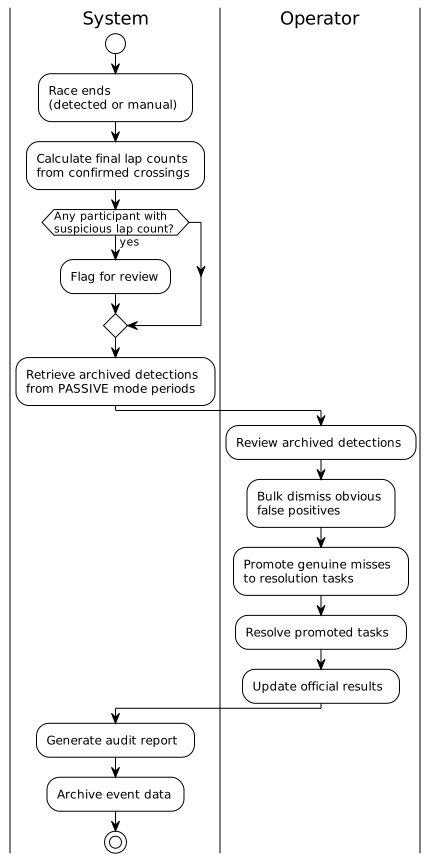
5.9.3. Post-Race Review Mode
After the race concludes, operators can review archived detections from PASSIVE mode:
-
System presents archived video-only detections from the race
-
Operator can bulk-dismiss obviously false detections
-
Remaining items can be promoted to tasks for resolution
-
Particularly useful for verifying results before official publication
5.10. Module 9: Review Console (RC)
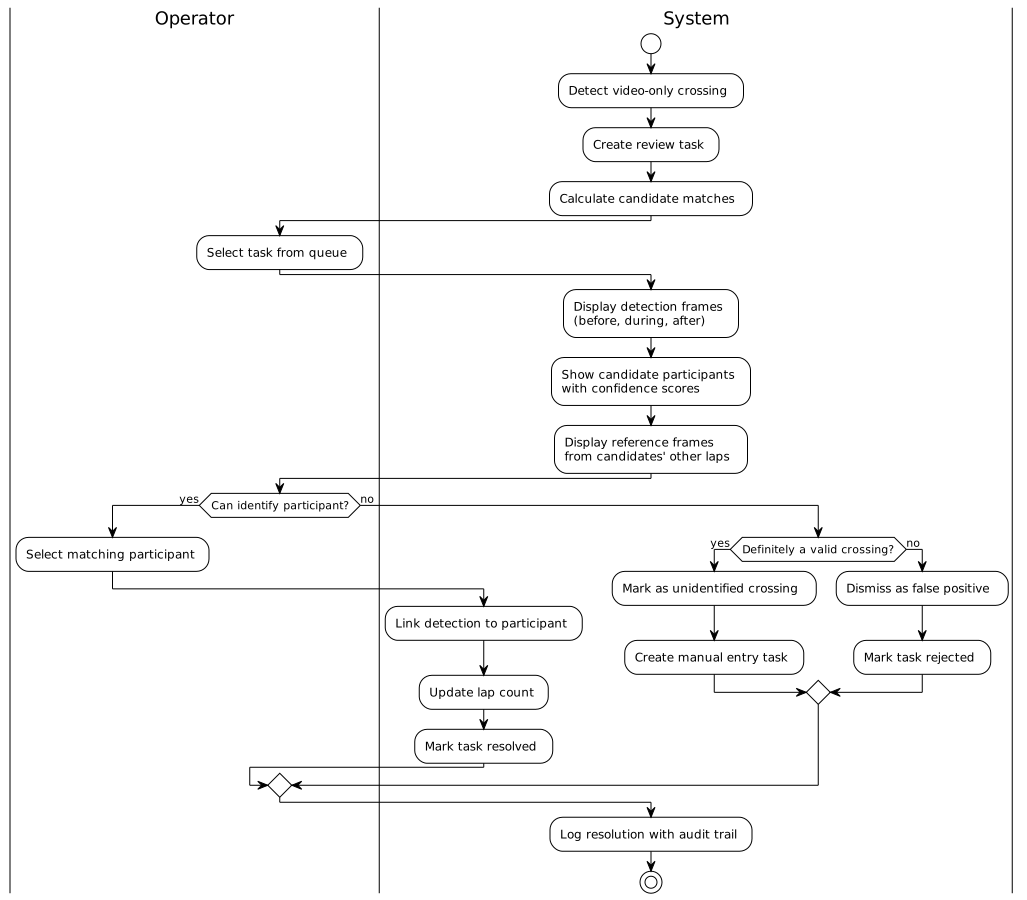
Operator interface for reviewing flagged events and resolving discrepancies.
| ID | Requirement | Priority |
|---|---|---|
RC-01 |
SHALL display video frames before, at, and after each flagged detection |
Must |
RC-02 |
SHALL show all available data for the detection (timestamp, confidence, camera source) |
Must |
RC-03 |
SHALL display candidate participant matches with probability scores |
Must |
RC-04 |
SHALL show reference frames from other laps for candidate participants |
Must |
RC-05 |
SHALL allow operator to confirm, reject, or reassign participant identity |
Must |
RC-06 |
SHALL support playback of video segment around detection |
Must |
RC-07 |
SHALL allow manual timestamp adjustment if detection timing is incorrect |
Should |
RC-08 |
SHALL provide keyboard shortcuts for rapid task processing |
Should |
RC-09 |
SHALL show race context (current standings, lap counts) during review |
Should |
RC-10 |
SHALL support side-by-side comparison of detection frames with reference images |
Must |
6. Non-Functional Requirements
6.1. Performance
| ID | Requirement | Target |
|---|---|---|
NFR-P01 |
Video processing latency (frame to detection) |
< 200ms per frame |
NFR-P02 |
Trigger correlation latency |
< 500ms from detection |
NFR-P03 |
Task creation latency |
< 1 second from gap identification |
NFR-P04 |
System throughput — per race |
Support 300 participants, 4 cameras, 10 crossings/5 sec peak burst |
NFR-P05 |
System throughput — per event day |
Support 2000 total participants across multiple races |
NFR-P06 |
Frame retrieval for review |
< 2 seconds for any historical frame within current event |
NFR-P07 |
Mode transition latency |
< 5 seconds from trigger condition to mode change |
6.2. Reliability
| ID | Requirement | Target |
|---|---|---|
NFR-R01 |
System availability during event |
99.5% uptime |
NFR-R02 |
Data persistence |
Zero data loss for timing events and archived frames |
NFR-R03 |
Recovery from component failure |
< 30 seconds automatic recovery |
NFR-R04 |
Graceful degradation |
Continue timing-only operation if vision fails |
NFR-R05 |
RFID failure detection |
Detect feed loss within 10 seconds, transition to CRITICAL mode |
6.3. Scalability
| ID | Requirement | Target |
|---|---|---|
NFR-S01 |
Camera count |
Support 2-8 cameras per finish line |
NFR-S02 |
Participants per race |
Up to 300 concurrent participants |
NFR-S03 |
Participants per event day |
Up to 2000 across all races |
NFR-S04 |
Concurrent races |
Support 2 concurrent races (e.g., overlapping categories) |
NFR-S05 |
Historical storage |
Retain event data for 90 days minimum; archive capability for full season |
6.4. Usability
| ID | Requirement | Target |
|---|---|---|
NFR-U01 |
Operator training time |
< 2 hours for proficient use |
NFR-U02 |
Task resolution rate |
Experienced operator: 30 tasks/hour |
NFR-U03 |
False positive rate (NORMAL mode) |
< 20% of flagged events should be false positives |
NFR-U04 |
PASSIVE mode task suppression |
>95% of crossings handled without operator intervention when RFID reliable |
NFR-U05 |
Setup time (field) |
< 30 minutes from equipment arrival to system operational |
NFR-U06 |
Recalibration time (single camera) |
< 2 minutes via tablet/mobile interface |
7. Data Model
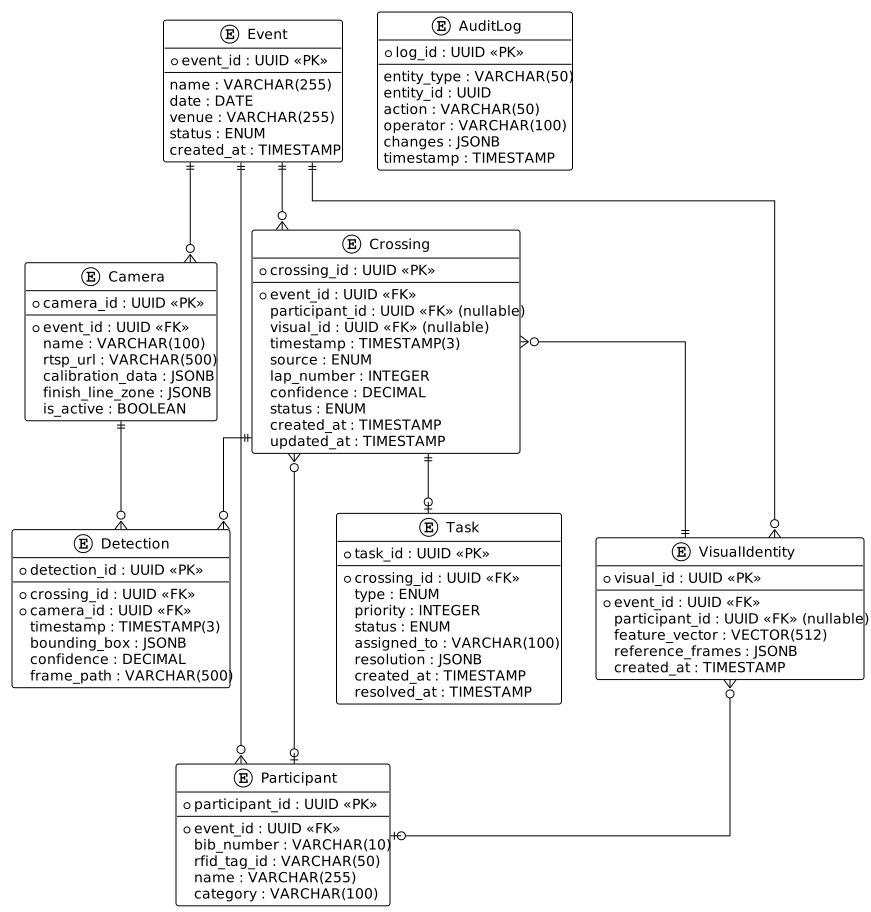
7.2. Enumeration Values
-
RFID_ONLY- Detected by timing system only -
VIDEO_ONLY- Detected by vision system only -
BOTH- Confirmed by both systems -
MANUAL- Manually entered by operator
-
CONFIRMED- Verified crossing with participant ID -
PENDING_REVIEW- Awaiting operator verification -
UNIDENTIFIED- Valid crossing, participant unknown -
REJECTED- Determined to be false positive
-
PENDING- Awaiting assignment -
IN_PROGRESS- Currently being reviewed -
RESOLVED- Completed with outcome -
DEFERRED- Postponed for later review
8. Tag-Server Integration
Since you have developed and control the tag-server, this provides significant flexibility for integration. This section outlines recommended extensions to the tag-server to optimise integration with the Vision Timing Augmentation System.
8.1. Recommended Tag-Server Extensions
If not already implemented, add an MQTT publisher that broadcasts crossing events to a configurable broker. This allows the Vision system to subscribe without any changes to existing timing software integrations.
# Conceptual implementation
import paho.mqtt.client as mqtt

class MQTTPublisher:
    def __init__(self, broker_host, broker_port=1883):
        self.client = mqtt.Client()
        self.client.connect(broker_host, broker_port)

    def publish_crossing(self, event_id, crossing):
        topic = f"timing/{event_id}/crossings"
        payload = json.dumps({
            "timestamp": crossing.timestamp.isoformat(),
            "tag_id": crossing.tag_id,
            "bib_number": crossing.bib_number,
            "reader_id": crossing.reader_id,
            "signal_strength": crossing.rssi,
            "read_count": crossing.consolidation_count,
            "sequence": crossing.sequence_number
        })
self.client.publish(topic, payload, qos=1)The RFID sports timing hardware performs signal strength filtering and reports only the strongest reading per crossing. This means the tag-server receives clean, consolidated data rather than raw reads.
Available metadata from tag-server (confirm which fields your hardware provides):
| Field | Description | Availability |
|---|---|---|
|
Precise crossing time from RFID hardware |
Always |
|
Unique identifier of the RFID tag |
Always |
|
Participant number (from tag mapping) |
Always |
|
Which reader/timing point generated the crossing |
Likely |
|
Monotonic sequence number for ordering |
Recommended to add |
Since the RFID hardware already filters to the strongest signal, fields like signal_strength and read_count may not be available. The pre-filtered data is actually advantageous — it reduces noise and provides cleaner input for correlation.
|
Consider adding a channel for the Vision system to query or update the tag-server:
| Endpoint | Purpose |
|---|---|
|
Retrieve participant list with bib-to-tag mappings |
|
Retrieve all crossings for a specific participant |
|
Submit a manually-added crossing from Vision system resolution |
|
System health check for monitoring |
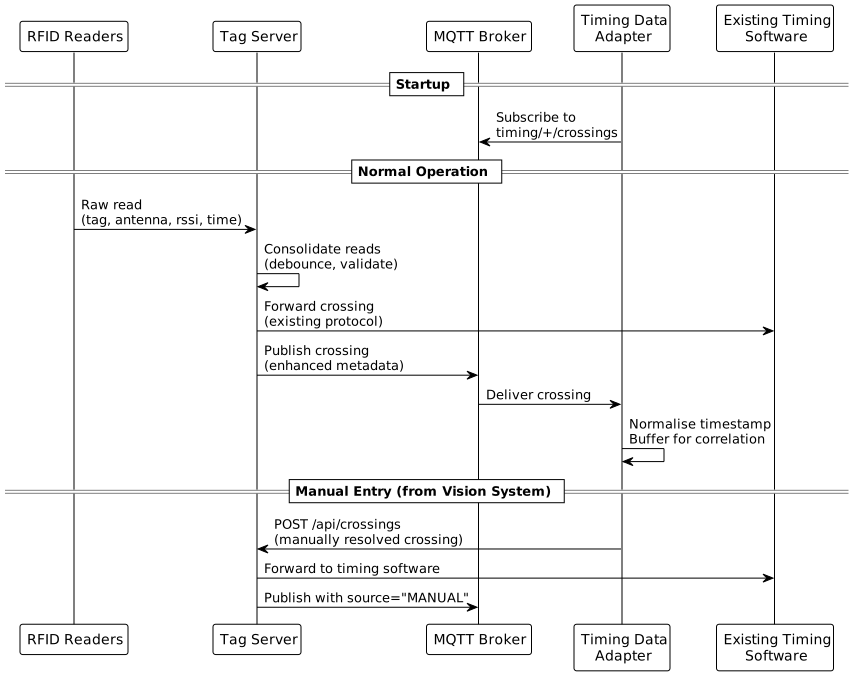
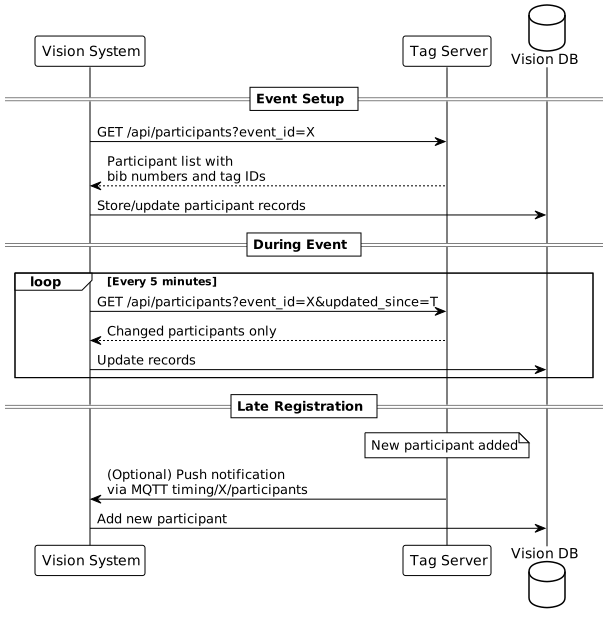
9. Technology Stack
9.1. Recommended Components
| Layer | Technology | Rationale |
|---|---|---|
Video Processing |
Python + OpenCV + FFmpeg |
Mature ecosystem, hardware acceleration support |
Object Detection |
YOLOv8 (Ultralytics) or YOLOv9 |
State-of-the-art accuracy, good speed, active development |
Deep Learning Runtime |
ONNX Runtime with CUDA/TensorRT |
Optimised inference, vendor-neutral |
Re-identification |
PyTorch + torchreid or fast-reid |
Pre-trained models available, customisable |
Message Broker |
Eclipse Mosquitto (MQTT) or EMQX |
Lightweight, reliable delivery, easy integration with tag-server |
Event Streaming |
Redis Streams |
Low-latency internal event streaming between modules |
Database |
PostgreSQL with pgvector extension |
Robust, supports vector similarity search for re-ID |
API Layer |
FastAPI (Python) |
High performance, async support, auto-documentation |
Operator UI |
React or Vue.js with TypeScript |
Component-based, responsive, good video support |
Deployment |
Docker + Docker Compose |
Portable, consistent environment, easy updates |
9.3. Hardware Recommendations
| Component | Minimum | Recommended |
|---|---|---|
CPU |
Intel i7-12700 / AMD Ryzen 7 5800X (8 cores) |
Intel i9-13900 / AMD Ryzen 9 7900X (12+ cores) |
GPU |
NVIDIA RTX 3060 12GB |
NVIDIA RTX 4070 12GB or RTX 4080 |
RAM |
32 GB DDR4 |
64 GB DDR5 |
Storage (System) |
500 GB NVMe SSD |
1 TB NVMe SSD |
Storage (Frame Archive) |
2 TB SATA SSD or HDD |
4 TB NVMe SSD (for faster retrieval) |
Network |
Gigabit Ethernet |
10 GbE or dual Gigabit (bonded) |
At 3MP resolution with YOLOv8-m (medium model):
-
Single RTX 3060: ~25-30 fps inference per stream
-
Single RTX 4070: ~40-50 fps inference per stream
-
For 4 cameras at 30 fps each = 120 fps total required
With batching optimisation, an RTX 4070 can handle 4 streams comfortably. For 8 cameras or future expansion, consider RTX 4080/4090 or dual GPUs.
| Scenario | Rate | Detection Requirement | Margin |
|---|---|---|---|
Sprint finish (peak burst) |
10 crossings / 5 sec = 2/sec |
Detect 2 bicycles per frame at 30 fps |
Comfortable — YOLO handles 50+ objects/frame |
Sustained bunch crossing |
50 crossings / 15 sec = 3.3/sec |
Detect 3-4 bicycles per frame |
Comfortable |
Busy period average |
300 crossings / 4 min = 1.25/sec |
Detect 1-2 bicycles per frame |
Very comfortable |
During sprint finishes, multiple cyclists cross nearly simultaneously. The challenge is not detection speed but tracking identity through the crossing zone. At 2 crossings/second with 30 fps video, each cyclist is visible for approximately 15-20 frames (assuming ~0.5 second transit through zone). This provides adequate frames for:
-
Confident bicycle detection (multiple frame confirmation)
-
Object tracking assignment (ByteTrack/BoT-SORT)
-
Feature extraction for re-identification
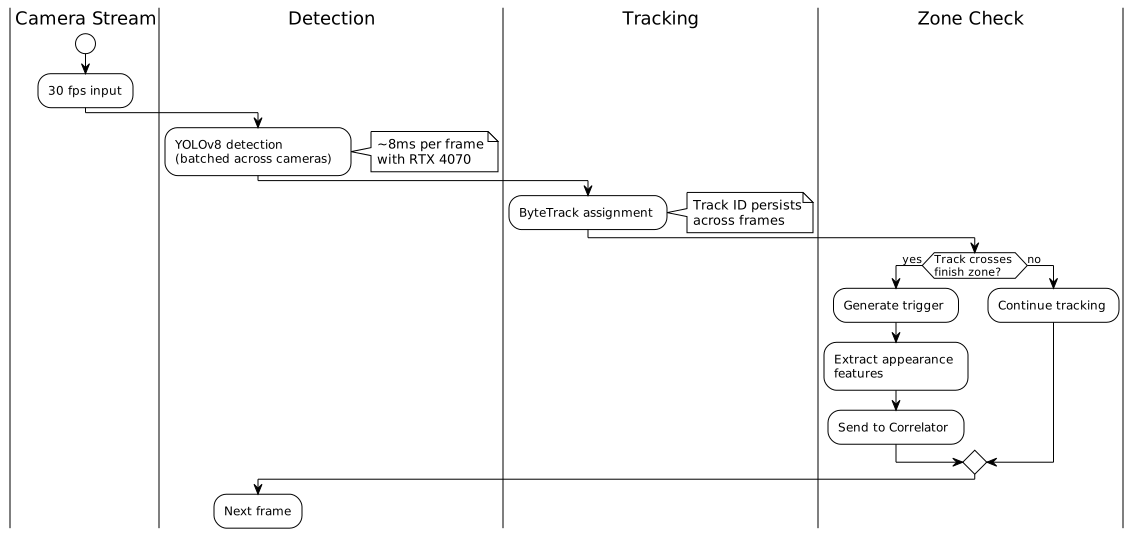
| The peak burst rate of 2 crossings/second is well within system capacity. The primary challenge during sprint finishes is maintaining distinct track IDs for closely-spaced cyclists, not raw detection throughput. |
| Parameter | Typical Value |
|---|---|
Participants per race |
50-300 |
Total participants per event day |
Up to 2000 |
Races per day |
5-15 |
Laps per race |
5-20 |
Crossings per day (maximum) |
2000 participants × 10 avg laps = 20,000 crossings |
Assuming we store key frames (not full video) for detected crossings:
-
~10 frames per crossing (before, during, after)
-
3MP JPEG at 80% quality ≈ 300 KB per frame
-
3 MB per crossing
| Scenario | Crossings | Storage |
|---|---|---|
Small event (500 participants, 8 laps avg) |
4,000 |
12 GB |
Medium event (1000 participants, 10 laps avg) |
10,000 |
30 GB |
Large event (2000 participants, 10 laps avg) |
20,000 |
60 GB |
| Retention Period | Storage Required |
|---|---|
Single event day |
60 GB (worst case) |
30 days (4 events/month) |
240 GB |
90 days (12 events) |
720 GB |
Full season archive |
2-4 TB |
Recommendation: 2 TB NVMe SSD for active/recent events, with archival to HDD or cloud storage for historical data.
9.4. Time Synchronisation
Accurate time synchronisation is critical for correlating video detections with timing triggers. Your infrastructure provides excellent options for achieving sub-millisecond accuracy.
| Source | Description | Accuracy |
|---|---|---|
Local NTP Server |
Already deployed at events |
1-10 ms typical |
RFID Timing GPS |
Built into timing system hardware |
<1 ms (internal use) |
Stratum 1 PTP/NTP Device (optional) |
GPS-disciplined hardware clock with PTP and NTP output |
<100 µs with PTP, <1 ms with NTP |
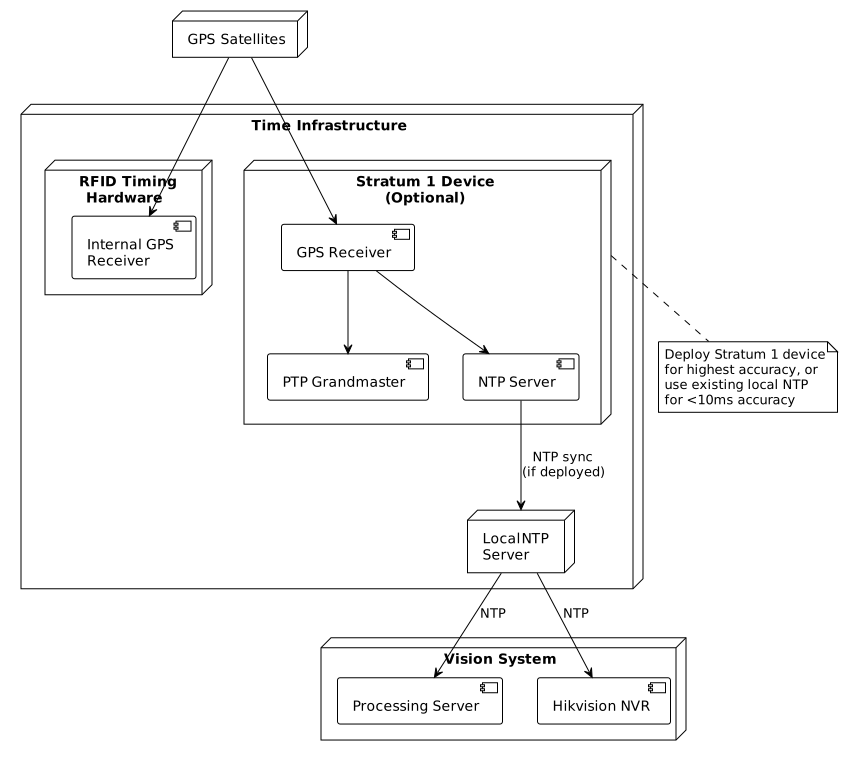
Option A: Use Existing Local NTP (Simpler)
-
All devices sync to local NTP server
-
Expected accuracy: 1-10 ms between systems
-
Sufficient for ±2 second correlation window
-
No additional hardware required
Option B: Deploy Stratum 1 Device (Higher Accuracy)
-
GPS-disciplined Stratum 1 provides authoritative time
-
Use PTP for processing server (if NIC supports IEEE 1588)
-
Use NTP for NVR and other devices
-
Expected accuracy: <1 ms between systems
-
Enables tighter correlation window and more precise timestamps
| System | Sync Method | Notes |
|---|---|---|
Processing Server |
NTP (or PTP if available) |
Primary correlation engine; highest accuracy beneficial |
Hikvision NVR |
NTP |
Frame timestamps from NVR metadata, not decode time |
Tag Server |
NTP |
Should sync to same source as processing server |
RFID Hardware |
Internal GPS |
Provides authoritative crossing timestamps; already accurate |
Before each event, verify synchronisation:
# On processing server
$ chronyc sources -v
$ chronyc tracking

# Check offset is <10ms (ideally <1ms)
# Check NVR time via ISAPI or web interface
# Compare tag-server timestamp with server clockThe correlation window (time tolerance for matching video and RFID triggers) should be set based on synchronisation accuracy:
| Sync Accuracy | Recommended Window | Notes |
|---|---|---|
<1 ms (PTP) |
±500 ms |
Tight matching, fewer false correlations |
1-10 ms (NTP) |
±1 second |
Default; accounts for typical NTP jitter |
10-50 ms (poor NTP) |
±2 seconds |
Conservative; may increase false matches |
Unknown/unsynchronised |
±3 seconds |
Emergency fallback only; verify sync ASAP |
10. Potential Issues and Mitigations
10.1. Technical Risks
| Risk | Description | Mitigation | Severity |
|---|---|---|---|
R01 |
Camera occlusion during peloton crossings |
Multiple camera angles, use timing system as primary during bunch finishes |
High |
R02 |
Insufficient detection accuracy in poor lighting |
IR-capable cameras, model fine-tuning on low-light data, pre-event lighting assessment |
Medium |
R03 |
Video stream latency causing correlation failures |
Configurable correlation window, NTP synchronisation, timestamp buffering |
Medium |
R04 |
Re-identification failures for similar kit/bikes |
Multiple feature extraction, operator override capability, don’t rely solely on re-ID |
Medium |
R05 |
Network bandwidth saturation |
H.265 compression, frame rate reduction, dedicated network segment |
Medium |
R06 |
GPU memory exhaustion with multiple streams |
Batch processing, model quantisation (FP16/INT8), queue management |
Medium |
R07 |
Timing system integration complexity |
Modular adapter design, file-based fallback, early integration testing |
High |
R08 |
Camera movement during event (wind, accidental contact) |
Continuous drift detection with reference points, auto-correction for minor drift, immediate alerts for significant movement |
High |
R09 |
Tripod instability on uneven ground |
Use weighted tripods, sandbags, or ground stakes; pre-event stability check |
Medium |
R10 |
Calibration loss between events |
Store calibration profiles per venue; quick recalibration workflow; consider fixed mounting points at regular venues |
Low |
10.2. Operational Risks
| Risk | Description | Mitigation | Severity |
|---|---|---|---|
R11 |
Operator overwhelmed by task volume during sprint finish |
Priority-based queuing, bulk dismiss for low-confidence, realistic throughput expectations; defer non-critical tasks until after race |
High |
R12 |
Calibration drift during event |
Continuous reference point monitoring, automatic drift detection and alerting, rapid field recalibration workflow |
Medium |
R13 |
Over-reliance on vision system |
Clear messaging that vision augments (not replaces) RFID, maintain manual processes |
Medium |
R14 |
Power or hardware failure |
UPS for critical components, graceful degradation to timing-only mode |
Medium |
R15 |
Setup time pressure |
Streamlined calibration workflow, pre-configured camera profiles, checklist-driven setup procedure |
Medium |
R16 |
Adverse weather affecting cameras |
Weather covers for tripods, lens hoods, hydrophobic lens coatings; contingency for rain delays |
Low |
10.3. Issues with Original Proposal
| Area | Concern and Recommendation |
|---|---|
OCR on frame boards |
Motion blur and oblique angles make OCR unreliable. Recommendation: Treat OCR as a "nice to have" enhancement, not a core identification method. Focus on visual re-identification using whole-person appearance features. |
Real-time identification requirement |
Expecting real-time participant identification from video alone is ambitious. Recommendation: Design for post-crossing resolution workflow; real-time correlation is feasible, but positive identification may require operator input. |
Single trigger per crossing |
Assuming cameras won’t generate multiple triggers is optimistic, especially with tracking jitter. Recommendation: Implement debouncing with configurable time window (e.g., 1 second) per camera before fusion. |
"Same frequency per lap" assumption |
Lap times can vary significantly (breakaways, mechanicals, fatigue, tactics). Recommendation: Use prediction with wide confidence intervals; don’t over-constrain matching based on expected times. |
Multi-camera fusion complexity |
Homography-based fusion requires careful calibration and assumes a flat ground plane. Recommendation: Start with simpler timestamp-based fusion; add spatial fusion as enhancement. |
Arbitrary visual ID stability |
Visual embeddings can drift or fail to match across lighting changes. Recommendation: Use visual ID as supporting evidence, not authoritative; always allow operator override. |
11. Suggested Improvements
11.1. Priority 1: Core Functionality
-
Add confidence thresholds throughout the pipeline - Don’t create tasks for very low-confidence detections; configure thresholds per module.
-
Implement a "bunch crossing" mode - When many cyclists cross simultaneously, switch to a simplified workflow that focuses on count verification rather than individual identification.
-
Pre-event model validation - Include a test/calibration phase before each event where known participants make test crossings to verify detection and camera setup.
-
Offline processing capability - Support post-race batch processing of video for events where real-time processing isn’t critical or hardware is limited.
11.2. Priority 2: Enhanced Accuracy
-
Multi-frame detection confirmation - Require detection in N consecutive frames before generating a trigger (reduces false positives from momentary misclassifications).
-
Tracking-based triggers - Use object tracking (e.g., ByteTrack, BoT-SORT) within each camera view to generate a single trigger per tracked object crossing the line, rather than per-frame detections.
-
Direction filtering - Only trigger for bicycles moving in the expected direction (towards/across finish line), filtering out cyclists warming down or crossing backwards.
11.3. Priority 3: Operational Efficiency
-
Configurable automation levels - Allow events to choose: fully manual review, semi-automated (high-confidence auto-accept), or post-race batch mode.
-
Mobile operator interface - Tablet-friendly UI for officials who may not be at a desk.
-
Integration with results publication - API to push corrections to existing results systems.
11.4. Priority 4: Future Enhancements
-
Multi-finish-line support - For stage races or events with intermediate timing points.
-
Cloud processing option - Offload GPU-intensive processing to cloud infrastructure for smaller events without dedicated hardware.
-
Machine learning feedback loop - Use confirmed resolutions to improve re-identification model over time.
13. Testing Strategy
13.1. Test Environment
A realistic test environment is essential for validating the system before deployment at live events.
| Component | Approach |
|---|---|
Video Streams |
Record sample footage from actual events; replay via RTSP simulator |
Timing Data |
Export historical crossing data from tag-server; replay with timestamps adjusted |
Synchronisation |
Verify correlation works correctly with recorded data before live testing |
Ground Truth |
Manually annotate test footage with actual crossings for accuracy measurement |
-
Minimum 3 events with different conditions (lighting, participant density)
-
Include examples of: bunch crossings, solo breakaways, missed RFID reads
-
Annotate ground truth for at least 500 crossings
-
Include edge cases: obstructed cameras, similar kit colours, mechanical incidents
13.2. Accuracy Metrics
| Metric | Definition | Target |
|---|---|---|
Recall (Sensitivity) |
Crossings detected / Actual crossings |
> 95% |
Precision |
True crossings / All detections |
> 85% |
F1 Score |
Harmonic mean of precision and recall |
> 90% |
| Metric | Definition | Target |
|---|---|---|
Match Rate |
Correctly correlated pairs / Total RFID triggers |
> 98% |
False Gap Rate |
False video-only detections / Total video-only |
< 15% |
Missed Gap Rate |
Undetected actual RFID misses / Total RFID misses |
< 10% |
| Metric | Definition | Target |
|---|---|---|
Rank-1 Accuracy |
Correct match is top candidate |
> 70% |
Rank-5 Accuracy |
Correct match in top 5 candidates |
> 90% |
13.3. Test Scenarios
-
50 participants completing 10 laps each
-
RFID read rate: 99%
-
Expected: ~5 video-only detections flagged for review
-
Validate: Correct gap detection and task creation
-
30 participants crossing within 10 seconds
-
Some RFID collisions causing missed reads
-
Expected: Multiple video detections, operator can identify by position/appearance
-
Validate: System handles high-density crossings without crashing
-
Single camera blocked for 30 seconds
-
Participants cross during occlusion
-
Expected: Timing-only detections logged, no false gaps created
-
Validate: Multi-camera fusion compensates, or graceful degradation
-
Dawn/dusk footage with low contrast
-
Expected: Detection confidence lower but still functional
-
Validate: System adjusts thresholds or flags low-confidence detections
13.4. Pre-Event Validation Checklist
Before each event, the following checks should be completed:
| # | Check | Status |
|---|---|---|
1 |
Tripods positioned with clear view of finish line, weighted/secured |
|
2 |
Cameras mounted and connected to NVR |
|
3 |
Camera streams accessible and decoding correctly on processing server |
|
4 |
Network connectivity verified between all components |
| # | Check | Status |
|---|---|---|
5 |
Each camera calibrated with finish line zone marked |
|
6 |
Reference points identified and stored for drift detection (4-6 per camera) |
|
7 |
Multi-camera fusion verified (if overlapping views) |
|
8 |
Test crossing detected correctly in finish zone |
| # | Check | Status |
|---|---|---|
9 |
Tag-server MQTT/WebSocket connection established |
|
10 |
Participant list synchronised from tag-server |
|
11 |
Time synchronisation verified (<10ms drift across all systems) |
|
12 |
Test crossing detected by both RFID and video, correctly correlated |
| # | Check | Status |
|---|---|---|
13 |
Operator console accessible and displaying real-time status |
|
14 |
Task queue empty or containing only test items |
|
15 |
Frame retrieval working for test crossing timestamp |
|
16 |
Alert sounds/notifications audible at operator position |
|
17 |
Database backup configured and tested |
| # | Check | Status |
|---|---|---|
18 |
Perform 2-3 full test crossings with known participants |
|
19 |
Verify detection, correlation, and task workflow end-to-end |
|
20 |
Confirm camera drift detection baseline is stable |
|
21 |
Brief all operators on alert levels and recalibration procedure |
14. Implementation Phases
14.1. Phase 1: Foundation (4-6 weeks)
-
Video Stream Adapter with Hikvision integration
-
Basic Bicycle Detector with single camera
-
Timing Data Adapter for your specific system
-
Simple Trigger Correlator (timestamp-based)
-
Minimal operator UI showing correlated events
-
Successfully ingest video from NVR
-
Detect bicycles with >80% recall on test footage
-
Correlate timing and video triggers within 2-second window
14.2. Phase 2: Multi-Camera & Tasks (4-6 weeks)
-
Camera Fusion Module with calibration UI
-
Task Manager with prioritisation
-
Review Console with frame display
-
Gap analysis and reporting
-
Process 4 cameras simultaneously
-
Generate tasks for video-only detections
-
Operator can resolve tasks and update records
14.3. Phase 3: Intelligence (6-8 weeks)
-
Visual Re-Identification Engine
-
Lap Predictor with confidence scoring
-
Enhanced Review Console with candidate matching
-
Reference frame retrieval
-
Consistent visual ID assignment (>70% accuracy across laps)
-
Lap predictions within 5% of actual for stable riders
-
Operators can use reference frames for identification
14.4. Phase 4: Hardening & Optimisation (4 weeks)
-
Performance optimisation for target hardware
-
Comprehensive error handling and recovery
-
Full audit logging
-
Documentation and operator training materials
-
Meet all non-functional requirements
-
Successfully complete pilot event
-
Operator confidence in system reliability
15. Appendices
15.1. Appendix A: Glossary
| Term | Definition |
|---|---|
Bib Number |
Race number worn by participant, used for identification |
Correlation Rate |
Percentage of RFID triggers that have a matching video detection within the time window |
Crossing |
A single instance of a participant passing over the finish line |
Detection |
A single identification of a bicycle in a video frame |
Frame Board |
Panel mounted on bicycle displaying participant’s race number |
ISAPI |
Hikvision’s Integration Service API for accessing NVR features programmatically |
Lap |
One complete circuit of the race course |
NVR |
Network Video Recorder - device that records IP camera footage |
Peloton |
Main group of cyclists in a race |
Processing Mode |
System operational state (PASSIVE, NORMAL, ALERT, CRITICAL) based on correlation success |
RCP |
Race Context Provider - module that integrates with race administration software |
Re-ID |
Re-identification - matching a person across different camera views or times |
RFID |
Radio-Frequency Identification - technology used for timing tags |
Tag-Server |
Custom middleware that consolidates RFID reads and provides streaming output |
Trigger |
An event indicating a finish line crossing from any source |
VID |
Visual Identifier - temporary ID assigned based on visual appearance |
YOLO |
"You Only Look Once" - family of real-time object detection models |
15.2. Appendix B: Open Questions
| Question | Answer |
|---|---|
Timing system protocol |
Custom tag-server provides REST API, streaming (WebSocket), message broker, or MQTT |
Camera resolution/frame rate |
3MP colour at 30 or 60 fps |
Peak crossing rate |
10 crossings/5 sec burst, 50 crossings/15 sec sustained, 300 crossings/4 min average |
Fixed or portable setup |
Portable — pole/fence clamp mounts (more rigid than tripods); unique positions per event |
Signal strength metadata |
RFID hardware pre-filters to strongest signal; raw metadata not available from tag-server |
Time synchronisation |
Local NTP available; timing system has GPS; option for Stratum 1 PTP/NTP hardware |
Participant scale |
Up to 300 per race, 2000 per event day across multiple races |
Race scheduling |
Administration software provides start times (no-earlier-than) and expected duration |
NVR model |
Hikvision DS-7600NI series (Pro) |
-
What is the acceptable false-positive rate for operator review tasks?
-
Should the system support multiple simultaneous finish lines (e.g., criterium with start/finish separate from prime line)?
-
What is the interface to the race administration software? (REST API, database, file export?)
-
What timing software is downstream of the tag-server? Is there potential for direct integration with results publication?
-
What specific DS-7600 model variant? (Affects maximum concurrent playback streams)
-
What is the typical network infrastructure? (Dedicated switches, or shared with other event systems?)
-
What is the typical duration of individual races? (Affects frame archive sizing per race)
-
Are there mobile/tablet devices available for operators at the finish line?
15.3. Appendix C: References
-
YOLOv8 Documentation: https://docs.ultralytics.com/
-
Hikvision ISAPI Reference: (vendor documentation)
-
torchreid Library: https://github.com/KaiyangZhou/deep-person-reid
-
ByteTrack: https://github.com/ifzhang/ByteTrack
-
PostgreSQL pgvector: https://github.com/pgvector/pgvector